Getting to Asteroids: The Road Trip Begins
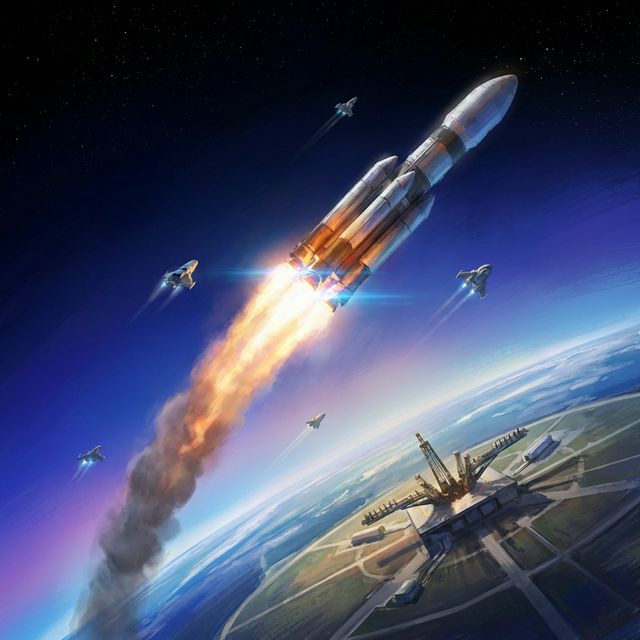
Hey there, space explorer! Welcome to Chapter 6, where we're buckling up for the exciting ride from Earth to those floating treasure chests we call asteroids. If you've been following along from the earlier chapters, you know asteroids are like nature's gift bags packed with metals, water, and other goodies. But how do we actually get there? Don't worry— we're keeping this simple, fun, and full of everyday examples. Think of this chapter as planning a family road trip: you've got your car (the spacecraft), gas (propulsion), and a map (trajectories). We'll cover every step, from blasting off to cruising through space, with plenty of "wow" moments and tips to make it stick. Ready? Let's launch!
Why This Trip Matters: A Quick Refresher
Before we dive in, remember why we're heading out: asteroids could solve big Earth problems, like running out of rare metals for phones or water for future space bases. Getting there isn't like hopping on a plane—space is vast, with no air, no roads, and tricky gravity. But humans have done it before! Missions like NASA's OSIRIS-REx (which snagged samples from asteroid Bennu in 2023) and Japan's Hayabusa2 (returning bits in 2020) show it's possible. These trips take months or years, but with smart tech, we're making them easier. Picture this: instead of guzzling gas like an old truck, we're learning to "sail" the stars. Cool, right?
Step 1: Blasting Off with Rockets – The Big Push
Okay, let's start at the beginning: how do we even leave Earth? It all begins with rockets, those towering beasts you've seen on TV launching with flames and thunder. Simply put, a rocket is like a giant firework that pushes a spacecraft up and out of our planet's grip. Gravity wants to pull everything down, so we need a huge "oomph" to escape—scientists call this escape velocity, about 11 kilometers per second (that's over 24,000 miles per hour!).
Think of it like this: imagine throwing a ball straight up. A weak toss falls back; a strong one goes higher. Rockets burn fuel (like liquid hydrogen and oxygen) to create hot gas that shoots out the back, pushing the rocket forward—Newton's third law in action: for every action, there's an equal opposite reaction. Common ones include SpaceX's Falcon 9 or NASA's SLS (Space Launch System), which can hurl spacecraft toward asteroids.
But here's the common-sense part: asteroids aren't as far as Mars or Jupiter. Many are near-Earth objects (NEOs), swinging close every few years. For example, asteroid Psyche (a metal-rich giant) is about 230 million kilometers away on average, but clever timing means we don't fly straight— we curve! This saves fuel, which is gold in space (literally, since asteroids have it). Reusable rockets like Falcon Heavy have dropped costs dramatically, making more missions feasible. Fun fact: the first asteroid mission, NEAR Shoemaker in 1996, used a Delta II rocket and orbited Eros for a year. Today, we're reusing boosters—talk about recycling!
What if something goes wrong? Rockets have backups, like multiple engines, and missions plan for "windows"—specific times when Earth and the asteroid align perfectly. Miss it? Wait a year or two. It's like catching a bus: timing is everything.
Step 2: Keeping Going – Propulsion: The Heart of the Journey
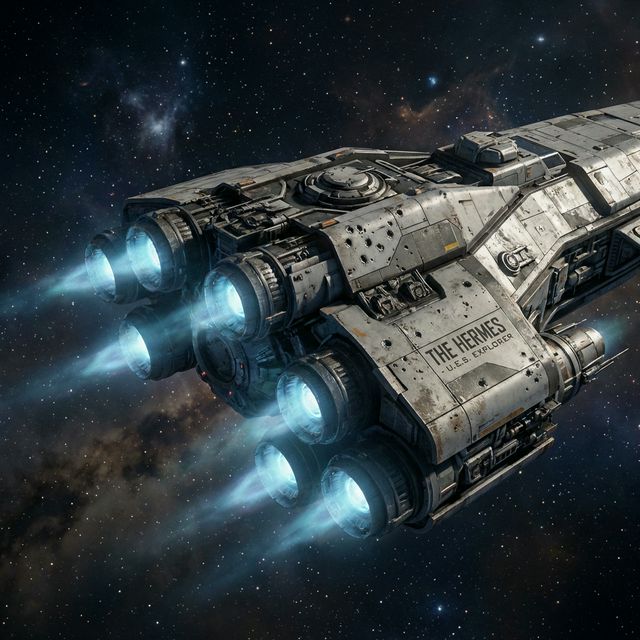
Once you're in space, gravity from the Sun and planets keeps you orbiting, but to steer toward an asteroid, you need propulsion. This is where things get clever. No more big booms; we switch to efficient "engines" that sip fuel over long hauls. Let's break it down like choosing a car for a cross-country drive: do you want a gas-guzzler for speed or an electric for mileage?
Chemical Rockets: The Quick Starters
These are your launch heroes, using chemicals like kerosene or hydrogen to create thrust. They're powerful but burn fuel fast—great for escaping Earth or quick adjustments, but not for months-long cruises. Analogy: like sprinting at the start of a marathon. For asteroids, we use them for the initial push and final tweaks, as in OSIRIS-REx's journey to Bennu (launched in 2016, arrived 2018). They provide delta-v (change in speed) of a few kilometers per second, but carry lots of heavy fuel.
Ion Thrusters: The Efficient Cruisers
Here's where sci-fi meets reality! Ion thrusters are electric engines that zap gas (like xenon) into charged particles (ions) and shoot them out at high speed. They're weak (thrust like a sheet of paper's weight) but super-efficient—using 10 times less fuel than chemical ones. Perfect for long trips! NASA's Dawn mission (2007-2018) used ion thrusters to visit Vesta and Ceres in the asteroid belt, traveling 5.9 billion kilometers on just 425 kg of fuel. For mining, they're ideal: slow but steady, like a tortoise winning the race. Newer ones, like NASA's NEXT (tested in 2024), process three times more power and could haul mining gear. Gridded ion thrusters accelerate ions via grids; Hall-effect ones use magnetic fields—both proven in space.
Solar Sails: Riding the Light
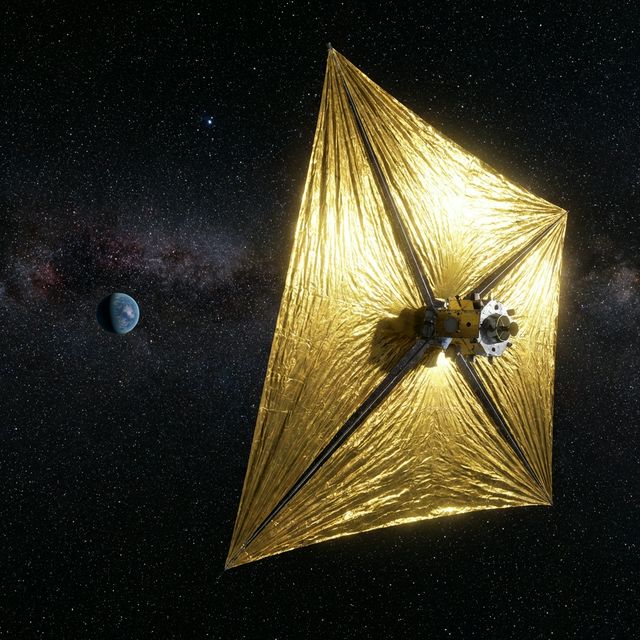
No fuel? No problem! Solar sails are giant, shiny sheets (thinner than hair) that catch sunlight like a sailboat catches wind. Photons (light particles) bounce off, giving a tiny push— but it adds up over time, reaching high speeds without propellant. JAXA's IKAROS (2010) was the first to sail to Venus; NASA's NEA Scout (launched 2022) aimed for an asteroid but lost contact—still, it showed promise. For mining, sails could scout thousands of NEOs cheaply, as Berkeley researchers propose with mini-sails. Analogy: gliding on a breeze instead of pedaling. Challenges? Slow starts near Earth (need a boost), but great for deep space. Future sails might use lasers for even faster pushes.
Bonus: Water from Asteroids as Fuel
Common sense alert: why carry all your gas? Mine it! C-type asteroids have water ice; split it into hydrogen and oxygen (electrolysis) for propellant. Companies like TransAstra plan "optical mining" with mirrors to heat and extract it, turning asteroids into gas stations. This in-situ resource utilization (ISRU) could refuel ion thrusters mid-mission, extending range.
Propulsion isn't one-size-fits-all—mix them! Chemical for launch, ion or sails for cruise. Missions like Psyche (launched 2023) use solar electric propulsion (SEP) with Hall thrusters, cutting fuel needs by 90%. As costs drop (thanks to reusables), more private firms like AstroForge eye this for profit.
Comparison of Propulsion Types:
| Propulsion Type | Simple Analogy | Best For | Real Example |
|---|---|---|---|
| Chemical Rockets | Sprint start | Launch/quick boosts | OSIRIS-REx launch |
| Ion Thrusters | Steady jog | Long cruises | Dawn to Vesta/Ceres |
| Solar Sails | Wind gliding | Fuel-free scouting | IKAROS to Venus |
Step 3: Plotting the Path – Trajectories: Your Space GPS
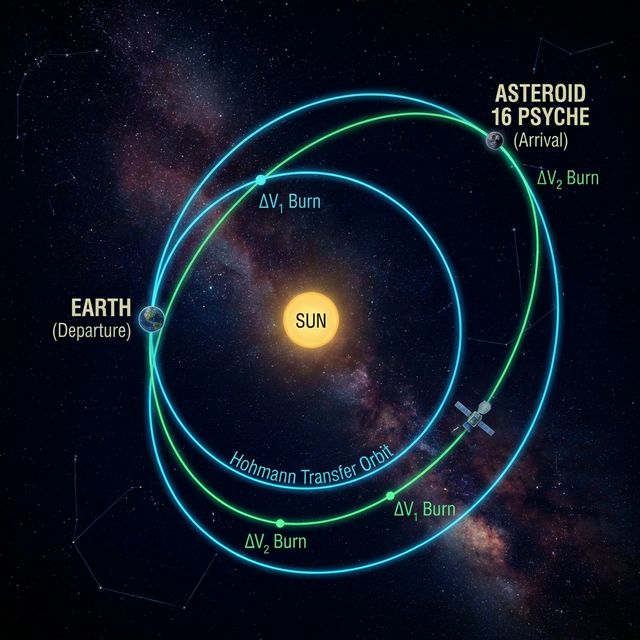
Now, the fun part: how do we navigate? Space isn't a straight line—planets move, gravity pulls. Trajectories are curved paths designed to save energy. Think road trip: avoid traffic, use shortcuts.
Hohmann Transfers: The Fuel-Saver Curve
Named after Walter Hohmann (1925), this is the go-to for efficiency. From Earth's orbit, you burn to enter an elliptical (oval) path touching the asteroid's orbit. At the far end, burn again to match speeds. Analogy: swinging on a playground—use momentum to go higher without extra push. For asteroids, it's ideal: OSIRIS-REx used one to reach Bennu in 2 years. Delta-v? About 5-6 km/s total. Time? 6-9 months for NEOs. Pro: minimal fuel. Con: fixed windows every 1-2 years.
Gravity Assists: Free Speed Boosts
Swing by a planet (like Earth or Venus) and "borrow" its gravity for a slingshot. Hayabusa2 used Earth's pull to speed up. It's like bumping a pinball for extra points—saves fuel but adds time.
Interplanetary Transport Network (ITN): Cosmic Highways
We touched on this in Chapter 5, but to recap: ITN uses Lagrange points (stable spots where gravity balances) as "tunnels" for low-energy paths. It's slow (years) but needs almost no fuel—perfect for cargo or scouts. Analogy: ocean currents carrying ships—let gravity do the work.
Choosing a trajectory? Depends on the asteroid. NEOs like 2024 YR4 need ~5.5 km/s delta-v from LEO; main-belt ones more. Tools like NASA's Trajectory Browser help plot. Real example: China's Tianwen-2 (2025 launch) uses Hohmann-like paths for sample return.
Overview of Trajectory Types:
| Trajectory Type | Energy Use | Time | Pro/Con |
|---|---|---|---|
| Hohmann Transfer | Medium | Months | Efficient but timed windows |
| Gravity Assist | Low | Variable | Free boost, adds detours |
| ITN | Very Low | Years | Cheap but slow |
Wrapping It Up: Ready for Arrival?
Challenges on the Way: What Could Go Wrong?
Space travel isn't all smooth sailing. Radiation zaps electronics (shield with asteroid rocks later?); communication delays (up to 20 minutes) mean autonomous bots; microgravity makes everything floaty. But solutions abound: AI pilots, better solar panels. Costs? Billions now, but dropping—Falcon Heavy launches for $90 million vs. old shuttles' billions.
Whew, we've covered the basics: rockets for launch, propulsion for power, trajectories for smarts. Getting to asteroids is like a well-planned adventure—exciting, efficient, and full of potential. Next chapter? Landing and attaching—sticking to a floating rock without floating away! Stay tuned, and dream big: one day, you might mine your own space gold.
Fun Quiz
Pause here and quiz yourself:
If a Hohmann transfer is like swinging, what's ITN?
Click to reveal answer
A cosmic lazy river!
Did you know? Asteroids spin; match their speed or risk a bumpy ride.
Key Citations:
- Wikipedia: Asteroid Mining
- NASA: New Mission to Mine Asteroids
- HowStuffWorks: How Asteroid Mining Will Work
- Wikipedia: Hohmann Transfer Orbit
- NASA Basics of Space Flight: Trajectories
- Wikipedia: Interplanetary Transport Network
- NASA JPL: Solar Sail Mission to Asteroid
- Wikipedia: Ion Thruster
- Frontiers: Trajectory Design for Asteroid Retrieval Missions
- Universe Today: Interplanetary Transport Network

Santhosh M Kunthe
✉️ santhoshmkska@gmail.com
📞 +91 9110460837