Embarking on the Cosmic Treasure Hunt
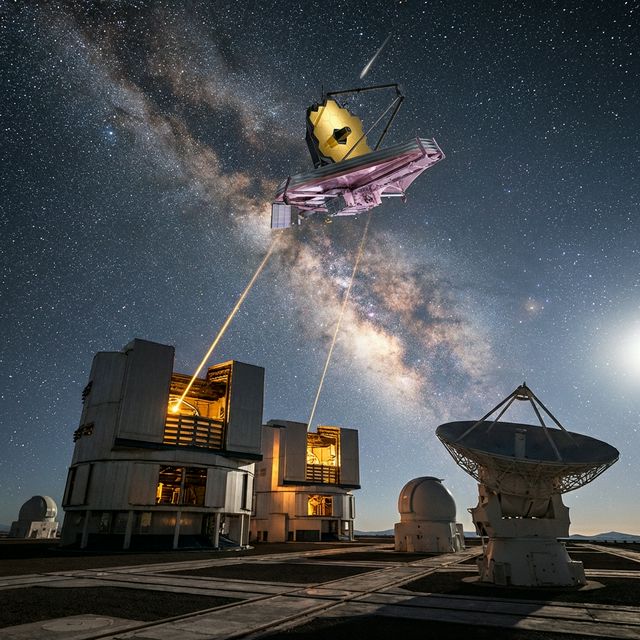
Picture this: You're planning a road trip to find hidden gems in a distant land. You wouldn't just hop in the car without a map, right? You'd scout the best spots, check the routes, and pick places with the most promise. That's exactly what finding and selecting asteroids for mining is like—a thrilling hunt in the vast "ocean" of space. In this chapter, we'll walk you through the basics of prospecting, or searching for these floating rocks, and how scientists decide which ones are worth the journey. We'll keep it simple, like chatting over coffee, using everyday examples to make sense of it all. By the end, you'll feel like you've joined the adventure, understanding why this step is crucial before any digging begins.
Asteroids aren't just random space debris; they're remnants from our solar system's birth, orbiting mostly in the asteroid belt between Mars and Jupiter. But for mining, we're interested in those that come closer—near-Earth asteroids (NEAs)—because they're easier to reach, like choosing a local park over a far-off mountain. As of early 2026, we've cataloged over 35,000 NEAs, but only a fraction might hold treasures like water, iron, or precious metals. The hunt involves spotting them, figuring out what they're made of, and weighing if they're practical to mine. It's a blend of astronomy, engineering, and a bit of detective work, with real missions showing us it's possible, though not without hurdles.
Spotting Asteroids from Afar – The Power of Telescopes
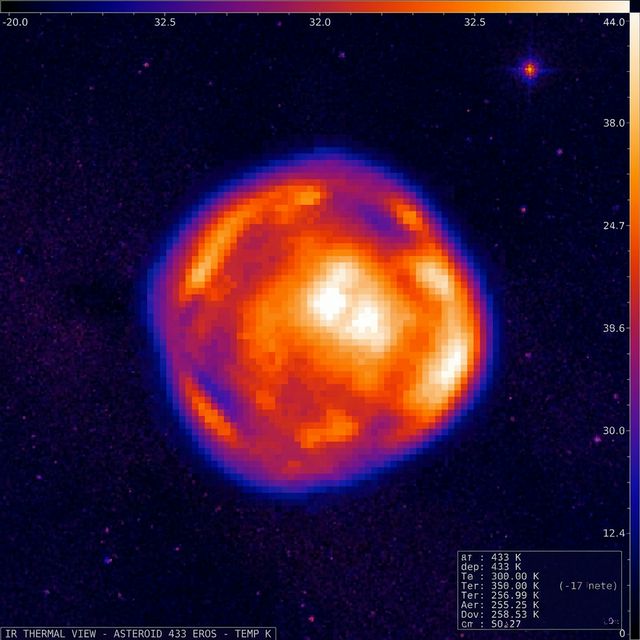
Let's start at the beginning: How do we even find these things? Think of asteroids as shy stars in a night sky full of distractions. We use telescopes as our first tool—big, powerful ones on Earth and even bigger ones in space.
Ground-based telescopes, like those at Mauna Kea in Hawaii or the Vera C. Rubin Observatory in Chile, scan the skies nightly. They look for moving points of light against the fixed stars, tracking their paths over days or weeks. These telescopes can spot asteroids as small as a few meters across, but they're limited by Earth's atmosphere, which blurs images like fog on a window. To get sharper views, we turn to space telescopes. NASA's Wide-field Infrared Survey Explorer (WISE), relaunched as NEOWISE in 2013, has discovered thousands of NEAs by detecting their heat signatures—asteroids glow in infrared like warm coals. Looking ahead, the NEO Surveyor mission, planned for launch in 2028, will be a game-changer. This infrared space telescope will hunt for hidden asteroids, potentially finding hundreds more suitable for mining each year.
But spotting is just the start. We need to know what's inside. Enter spectroscopy: By analyzing the light reflected off an asteroid, we can identify its composition. It's like using a prism to split sunlight into a rainbow—different materials absorb and reflect colors uniquely. For example, metallic M-type asteroids might shine brighter in certain wavelengths, hinting at iron or platinum. Radar telescopes, like the Goldstone Deep Space Communications Complex, bounce radio waves off asteroids to map their shape, size, and spin. This helps avoid surprises, like a lumpy rock that's hard to land on.
Fun fact: In 2025, amateur astronomers using backyard telescopes contributed to spotting a small NEA, showing anyone can join the hunt with apps like NASA's Asteroid Watch!
Getting Up Close – Probes and Robotic Scouts
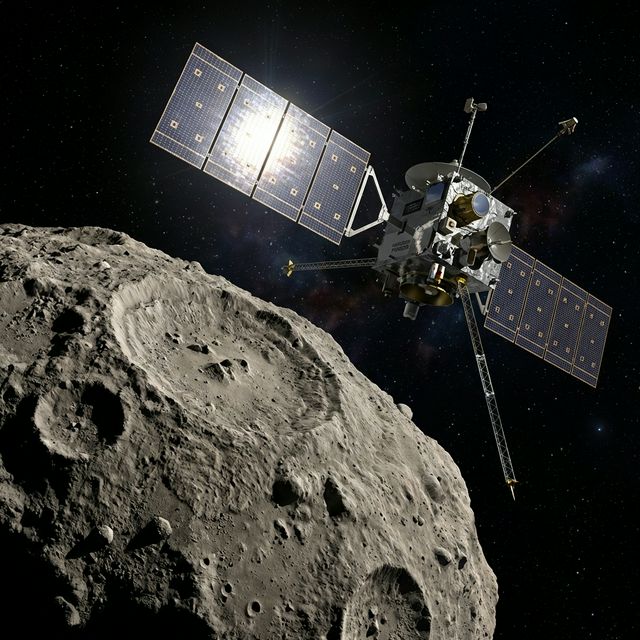
Once we've got a candidate from afar, it's time for a closer look. This is where space probes come in—think of them as remote-controlled drones sent on scouting missions. These robotic explorers fly millions of miles to rendezvous with asteroids, taking high-res photos, scanning surfaces, and even grabbing samples.
Take NASA's OSIRIS-REx mission: Launched in 2016, it reached the asteroid Bennu in 2018, mapped it in detail, and touched down in 2020 to collect over 60 grams of material, returning it to Earth in 2023. Bennu, a C-type asteroid rich in carbon and water, showed us how rubble-pile asteroids (loose gravel heaps) behave—tricky for mining but full of volatiles for fuel. Japan's Hayabusa2 did something similar with Ryugu in 2019, firing a projectile to kick up subsurface dust and bringing back 5 grams. These missions prove we can "prospect" by sampling, revealing hidden layers.
Private companies are jumping in too. AstroForge's Odin mission in 2025 aimed to fly by a metallic asteroid for imaging, though it faced setbacks; their follow-up Vestri in 2026 plans the first private asteroid landing. China's Tianwen-2, launched in 2025, is en route to Kamoʻoalewa for sampling by 2026, then heading to a comet—multi-target prospecting at its best.
Robotics play a key role here. Probes use arms or "touch-and-go" systems to poke surfaces without full landing, avoiding dust clouds in low gravity. Future swarms—fleets of tiny micro-probes—could cover more ground, like bees scouting a field. By 2026, the micro-probe market is booming, with AI enabling autonomous decisions.
The Selection Criteria – What Makes an Asteroid "The One"?
Now, the exciting part: Picking winners from thousands of options. It's like house hunting—you want location, value, and no major fixes. Scientists use several criteria, balanced for feasibility.
First, proximity and accessibility. Near-Earth asteroids (NEAs) are top picks because trips take months, not years. Easily Recoverable Objects (EROs) are small ones we can "grab and go." Delta-v, the speed change needed to reach them, is key—low delta-v means less fuel, like driving downhill. Aim for under 4.5 km/s relative to Earth.
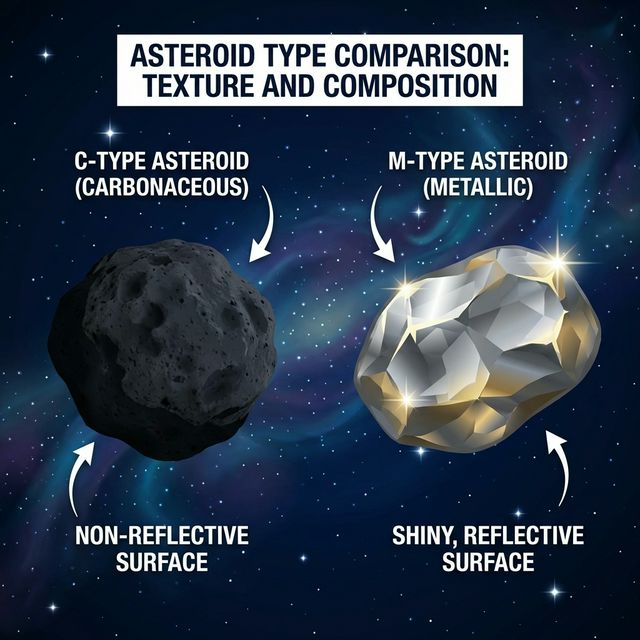
Second, composition and resources. We classify asteroids: C-type (water-rich, like wet sponges for fuel), S-type (stony with nickel-iron for building), M-type (metallic vaults of platinum and gold). For mining, M-types like Psyche (worth trillions?) are prizes, but we need at least 10 parts per million of valuables for profit. Spectroscopy helps, but samples confirm.
Third, size and physical traits. Bigger than 1km for enough material, but not too big to handle. Spin rate matters—fast spinners are hard to anchor, like grabbing a spinning top. Shape, density, and structure (monolithic rock vs. rubble pile) affect landing safety. Binary systems (with moons) add complexity.
| Criterion | Description | Why It Matters | Example |
|---|---|---|---|
| Proximity (NEAs) | Asteroids close to Earth's orbit | Shorter, cheaper trips | Bennu (OSIRIS-REx target) |
| Low Delta-V | Minimal velocity change needed | Saves fuel and costs | Under 4.5 km/s for viability |
| Composition | High in metals/water | Economic value | M-type like Psyche |
| Size | >1km diameter | Enough resources | Psyche (~226km) |
| Spin/Shape | Slow spin, regular form | Easier landing/mining | Avoid fast rotators > few hours |
This table summarizes the basics—use it as your "shopping list" for asteroid selection.
Economic factors weigh in too. A $1 billion market value minimum, per experts, balances costs. But remember, it's not just about money; sustainability and space treaties promote fair sharing.
Challenges in the Hunt: What Could Go Wrong?
No adventure is without bumps. Finding asteroids is tough because many are small and dark, hiding in the sun's glare. We've cataloged big ones, but millions of smaller prospects evade detection—NEOWISE helps, but we need more surveys.
Identification is unreliable; spectroscopy from Earth gives estimates, but compositions vary internally. Missions like OSIRIS-REx revealed Bennu was more watery than thought, but surprises like dust ejections add risks. High costs—billions per probe—limit missions, and microgravity makes close-ups tricky; dust can cloud sensors or damage gear.
Legal and ethical issues loom: The Outer Space Treaty says space is for all, but who owns mined goods? Debates rage on environmental impacts, like creating debris. Plus, economic hurdles—flooding markets with platinum could crash prices.
A 2025 study found mining undifferentiated asteroids unviable without better tech, emphasizing low-gravity extraction challenges.
Future Technologies: What's on the Horizon?
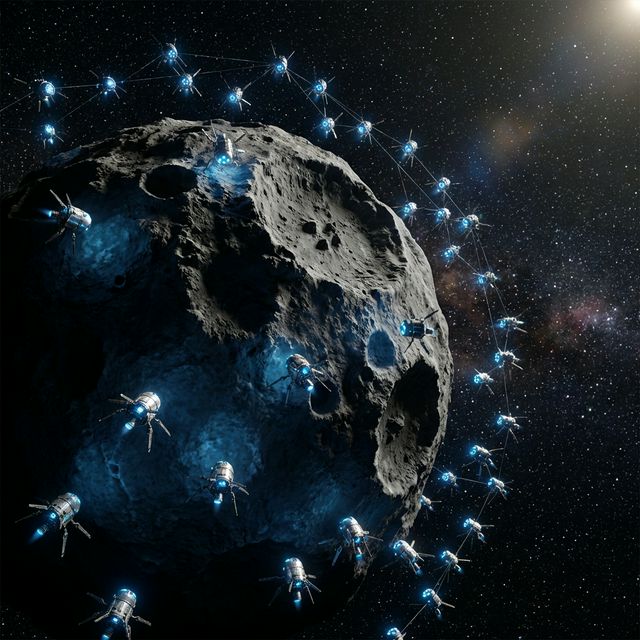
Exciting times ahead! By 2030, AI will revolutionize prospecting—machine learning analyzes data faster, spotting patterns humans miss. NASA's Asteroid Data Hunter uses AI for new discoveries. Swarm tech—hundreds of cheap micro-probes—will map asteroids collaboratively, like a team of ants.
In 2026, ExLabs' Apophis mission tests prospecting tools on a close-passing asteroid, including radar for metals. Private firms like AstroForge aim for deep-space landings, while ispace and Asteroid Mining Corporation plan lunar robots adaptable to asteroids.
Optical mining—using sunlight mirrors to vaporize ice—could prospect volatiles without touching down. By 2040, full-scale ops might use these, per forecasts.
Wrapping Up: From Hunt to Harvest
We've covered the full flow: spotting with telescopes, close-ups via probes, selection criteria, challenges, and future tech. This hunt builds on prior chapters—knowing asteroid types helps pick the best. Next, we'll explore getting there.
Quiz
What's delta-v like in everyday terms? (Answer: Choosing the easiest path to save energy.)
Click to reveal answer
Choosing the easiest path to save energy.
Key Citations:
- Wikipedia on Asteroid Mining
- How Asteroid Mining Will Work
- Asteroid Mining Methods
- Method, apparatus, and system for asteroid prospecting and mining
- Beginner's Guide to Asteroid Mining
- Mining asteroids could unlock untold wealth – here's how to get started
- New NASA Mission to Help Us Learn How to Mine Asteroids
- Asteroid Mining - MIT
- Scientists Analyse Feasibility And Challenges Of Asteroid Mining
- A Return to Asteroid Mining, and Digging Into Space Ethics with Joel Sercel
- Asteroid Prospecting Micro-Probe Market Report 2026
- ExLabs Selects Adds CUS-GNC SpacePilot Autonomy Software Heading to Asteroid Apophis
- AstroForge - Unlocking deep space resources through asteroid mining
- ispace and Asteroid Mining Corporation Agree to Pursue Future Mission to the Moon
- How Feasible Is Asteroid Mining? A New Study Investigates

Santhosh M Kunthe
✉️ santhoshmkska@gmail.com
📞 +91 9110460837