Strategic Architecture for Multi-Planetary Expansion
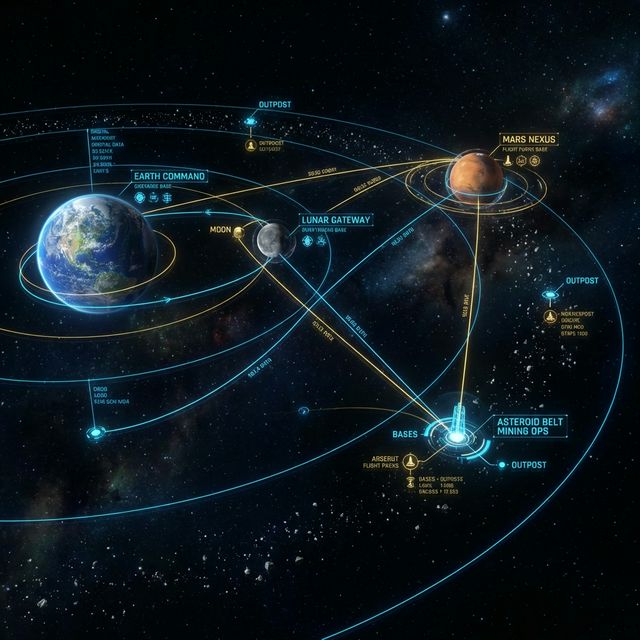
Imagine you’re planning the biggest road trip of all time—not across a country, but across the entire solar system. You wouldn’t just jump in the car and floor it to the farthest destination. You’d build gas stations, rest stops, repair shops, and warehouses along the way. That’s exactly what “strategic architecture for multi-planetary expansion” means. It’s a smart, connected network of bases and outposts placed at the best spots in space so we can live, work, and mine asteroids without running out of fuel, water, or safety.
This isn’t science fiction anymore. It’s the logical next step after we solve the problems from earlier chapters—like reaching asteroids, grabbing their resources, processing them on site, and creating artificial gravity so people can stay healthy. These locations act like stepping stones. Each one uses local resources (water ice for fuel, metals for building, sunlight for power) to support the next jump. The whole network makes asteroid mining cheaper, safer, and sustainable because you’re not launching everything from Earth every single time.
We split the plan into two tiers. Tier 1 is the “now or soon” foundation—places we can reach with today’s rockets and tech, places that give us practice and supplies. Tier 2 is the “next decade or two” expansion—bigger leaps that include the rich asteroid targets themselves. Let’s walk through them one by one, keeping it simple, like chatting over coffee about the smartest way to build a space civilization.
Tier 1: The Essential Stepping Stones (Close to Home, Doable Soon)
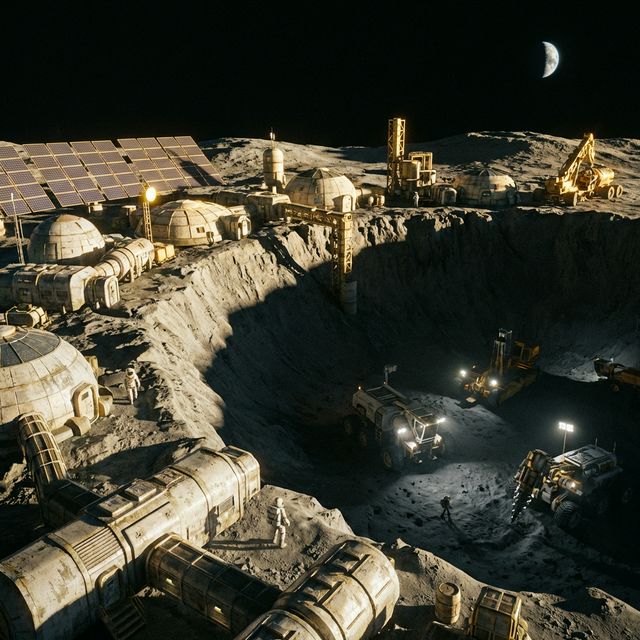
The Moon – South Pole (Shackleton Crater)
Picture a giant crater near the Moon’s south pole. Inside the crater it’s always dark and super cold—like a natural freezer that has trapped water ice from ancient comets. On the rim, tall mountain peaks get sunlight almost 24/7 (they’re called “peaks of eternal light”). So you get two things in one spot: endless solar power and water you can split into rocket fuel (hydrogen + oxygen) or drinking water. Common sense? Perfect first base. You test mining robots, build habitats, and launch to nearby asteroids far more easily than from Earth. The Moon’s low gravity also means it’s cheap to fly stuff off the surface.
Mars – Arcadia Planitia
This is a huge, flat plain in Mars’ northern mid-latitudes. Under the soil, just a few inches to a few feet down, there’s lots of clean water ice—enough to fill swimming pools. Flat ground means safe landings. The latitude gives decent sunlight without the extreme cold of the poles. Think of it as the “Midwest” of Mars: good farmland (once you melt the ice) and a perfect spot to practice living on another planet before going deeper into the asteroid belt.
Moon – Marius Hills Lava Tubes
Long ago, lava flowed under the Moon’s surface and left behind giant underground tunnels—some wide enough to fit a football stadium inside. These natural caves are already built! They shield you from deadly radiation, micrometeorites, and wild temperature swings (surface goes from boiling hot to freezing cold every two weeks). You can park habitats inside, stay comfortable, and use the Moon’s resources without fighting the harsh surface. It’s like finding a ready-made basement when you’re building a house.
Mars – Valles Marineris (Noctis Labyrinthus)
This is a crazy maze of canyons at the western end of the solar system’s biggest canyon system. Recent discoveries show a giant buried volcano here with possible glacier ice still underneath. The area has natural caves, sheltered valleys, and signs of ancient (and maybe recent) water. Near the equator, so more sunlight. It’s a fantastic spot for a Mars base because you get protection, water, and a highway of canyons to explore and mine resources while preparing to hop to nearby asteroids.
Low Earth Orbit (LEO) and Equatorial Low Earth Orbit (ELEO)
We’re already there! The International Space Station and future commercial stations orbit close to Earth. This is where we test everything—artificial gravity spinning stations, 3D printing with asteroid metals, fuel depots. Equatorial orbit is extra useful because Earth spins fastest there, giving rockets a free speed boost on launch. These orbits are the “home base” where we assemble big ships to fly to the Moon or asteroids.
Earth–Moon Lagrange Points L4, L5, L1
These are special “parking spots” in space where Earth’s and Moon’s gravity balance perfectly. L4 and L5 are stable—like sweet spots 60 degrees ahead of and behind the Moon in its orbit. You could build huge rotating habitats (O’Neill cylinders from Chapter 12) that stay put with almost no fuel. L1 sits between Earth and Moon and works as a gateway—easy to reach both worlds, perfect for a propellant depot or transfer station. Think of them as highway rest areas that never move.
Mars – Utopia Planitia
Another vast, flat plain on Mars (where China’s Zhurong rover landed). It shows signs of recent water activity—hydrated minerals and possible underground brines. Huge area means room to grow. It’s a second strong candidate for a Mars base, giving us options and backup sites.
Phobos
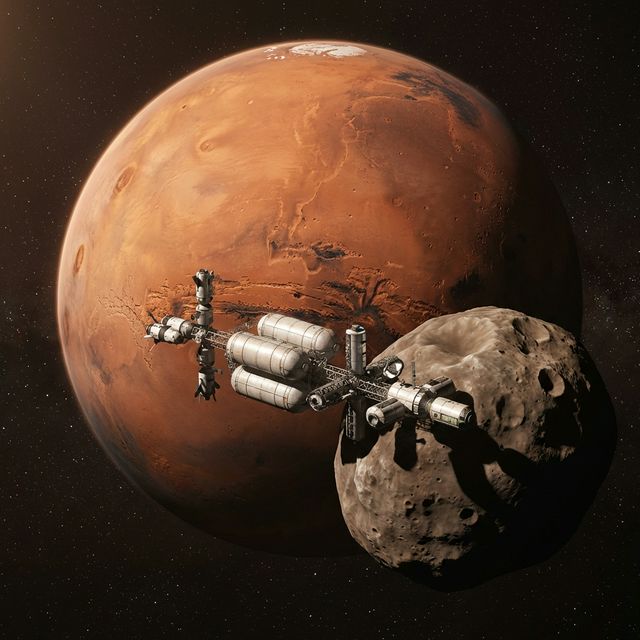
Mars’ inner moon— a tiny, potato-shaped rock that orbits very close. Almost zero gravity, so landing and taking off is easy (just hop!). It may contain material blasted off Mars itself. Many experts see Phobos as the perfect “staging platform” for Mars surface missions: you park your big ship here, send small landers down, refuel, and return without fighting Mars’ atmosphere and gravity every time. Smart shortcut.
Summary Table – Tier 1 Locations
| Location | Key Resources | Strategic Role | Why It Makes Sense (Common Sense) |
|---|---|---|---|
| Moon South Pole (Shackleton) | Water ice, near-constant sunlight | First off-Earth fuel & power station | Power + water in one place = self-sustaining |
| Mars Arcadia Planitia | Near-surface water ice, flat land | Safe landing, practice Mars living | Easy access to ice without extreme cold |
| Moon Marius Hills Lava Tubes | Natural shelter | Radiation-safe habitats | Ready-made caves—why build from scratch? |
| Mars Noctis Labyrinthus | Buried ice, caves, sunlight | Protected Mars base near equator | Water + shelter + energy |
| LEO / ELEO | Microgravity manufacturing | Testing & assembly hub | We’re already here—perfect training ground |
| Earth-Moon L4, L5, L1 | Stable orbits | Gateways & large habitats | Low-fuel parking spots in space |
| Mars Utopia Planitia | Hydrated minerals, possible ice | Backup Mars landing site | Room to expand, recent water evidence |
| Phobos | Low gravity, Mars ejecta | Staging point for Mars & asteroid trips | Easy in-and-out, shortcut to Mars surface |
Tier 2: Pushing the Frontier (Asteroids and Beyond)
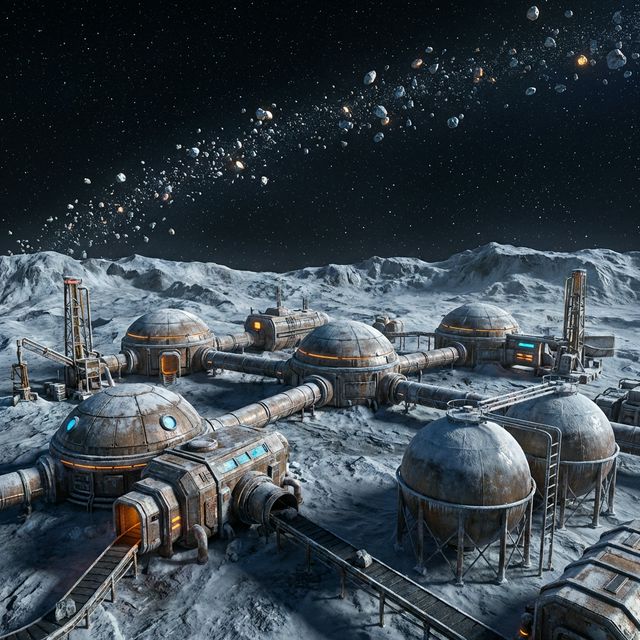
Once Tier 1 is running, we expand outward. These spots include the actual asteroid-mining targets and more distant outposts that feed the whole network.
Ceres
The largest object in the asteroid belt. It has huge amounts of water ice and even ammonia. A perfect “gas station” in the middle of the belt—mine water for fuel to reach other asteroids.
16 Psyche
The metallic monster we talked about in Chapter 3. Almost pure iron, nickel, and precious metals. Worth a fortune, and perfect for building spacecraft hulls right there in space.
Venus Upper Atmosphere
At about 50 km up, the air pressure and temperature are Earth-like! Scientists imagine floating cities in giant balloons. Could be a research outpost or manufacturing zone using Venus resources.
Mercury – North Pole (Permanently Shadowed Craters) & Subsurface Lava Tubes
Mercury is metal-rich and close to the Sun (great solar power). Its polar craters trap water ice, and lava tubes give radiation protection—just like on the Moon.
Near-Earth Asteroids: 4660 Nereus, 101955 Bennu
These are the “easy” ones—short trips from Earth. Bennu (visited by OSIRIS-REx) is carbon-rich with water and organics. Nereus is another accessible target. Perfect for early mining practice runs.
4 Vesta
Another big asteroid, rocky with metals. Good source of building materials.
Deimos
Mars’ outer moon. Similar advantages to Phobos but farther out—another low-gravity staging point.
Sun–Earth Lagrange Points L1 & L2
L1 is great for solar power stations and watching the Sun. L2 (where the James Webb Telescope sits) is a quiet, cold spot for big telescopes or deep-space fuel depots.
Summary Table – Tier 2 Locations
| Location | Key Resources | Strategic Role |
|---|---|---|
| Ceres | Massive water ice | Fuel depot in the asteroid belt |
| 16 Psyche | Iron, nickel, platinum-group metals | On-site spacecraft manufacturing |
| Venus Upper Atmosphere | Earth-like pressure & temperature | Floating research/manufacturing platforms |
| Mercury North Pole & Tubes | Water ice, metals, lava tubes | Solar-powered metal mining outpost |
| 4660 Nereus & Bennu | Water, organics, accessible | Early, low-cost asteroid mining targets |
| 4 Vesta | Rocky metals | Construction materials |
| Deimos | Low gravity | Extra Mars staging point |
| Sun–Earth L1 & L2 | Stable, solar energy or cold space | Power stations & observatories |
Why This Whole Architecture Works for Asteroid Mining
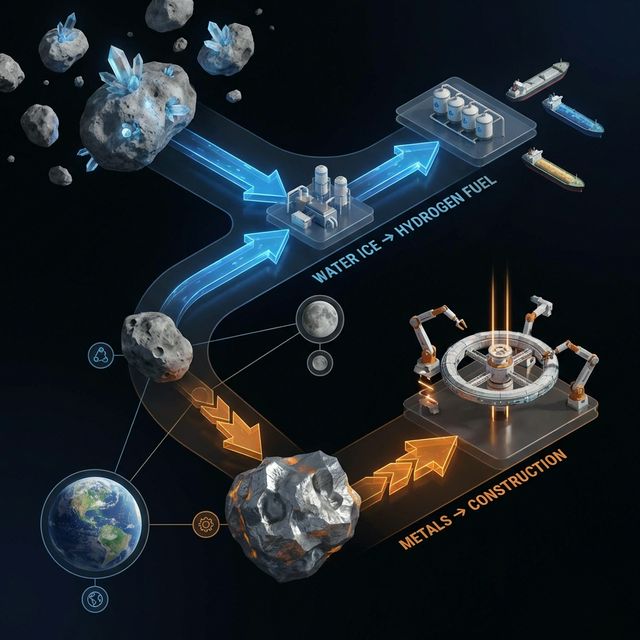
Think about it with everyday logic. Mining an asteroid is like fishing in the ocean—you need a boat, fuel, a place to process the catch, and a way to get home safely. These locations give you all of that:
- Refueling stations: (water ice → rocket fuel)
- Safe harbors: (lava tubes, low-gravity moons)
- Factories: (zero-g manufacturing at Lagrange points)
- Practice grounds: (Moon and Mars)
No single place does everything. The network does. A ship leaves Earth, stops at the Moon for fuel, swings by Phobos to drop off crew for a Mars mission, then heads to Psyche to mine metal. On the way back it tops up at Ceres. Every stop uses local resources so you launch less mass from Earth. That’s how asteroid mining becomes profitable instead of a trillion-dollar gamble.
Challenges remain—radiation, dust, communication delays—but we already have solutions from earlier chapters: artificial gravity habitats, robotic helpers, and ISRU (using space resources on site).
This architecture turns the solar system from a scary wilderness into a connected neighborhood. It’s not about planting flags; it’s about building a lasting human presence that lets us mine asteroids sustainably and expand safely.
In the next chapter, we’ll look even farther—Tier 3 and Tier 4 outposts on the icy moons of Jupiter and Saturn, and the most distant asteroids. The road keeps going, and the treasures get even more exciting.
See you in Chapter 15—where the real adventure beyond the asteroid belt begins!
← Back to Syllabus ← Chapter 13
Santhosh M Kunthe
✉️ santhoshmkska@gmail.com
📞 +91 9110460837